Employment Application Apply
Choosing a horizontal thin film evaporator is not simply a matter of comparing rated capacity and price. The right unit must match the feed’s viscosity, solids content, thermal sensitivity, and desired final concentration. A sticky polymer solution may need a different rotor and clearance than a light solvent stream. For heat-sensitive materials, short residence time and controlled wall temperature can help limit product damage. Small details count: inspect the heated surface, rotor design, seals, drive, and vapor outlet. That matters. A neat specification sheet can still hide uncertainty about fouling or cleaning. Ask suppliers for operating data from comparable feeds, not only ideal laboratory results.
This guide explains the selection questions that shape reliable performance in continuous service. It covers feed properties, evaporation duty, operating pressure, heat transfer, materials, and maintenance access. You’ll also see how throughput targets relate to film distribution and product quality. Consider what happens during startup, shutdown, and a brief feed interruption; real plants rarely run like a perfect diagram. Compare energy use and cleaning needs alongside purchase cost, since a low upfront price may not mean lower lifetime cost. Where process data are incomplete, say so openly. Pilot trials can expose assumptions before equipment is fixed. Not on paper alone. With measured feed samples and clear acceptance criteria, you can make a more defensible choice.
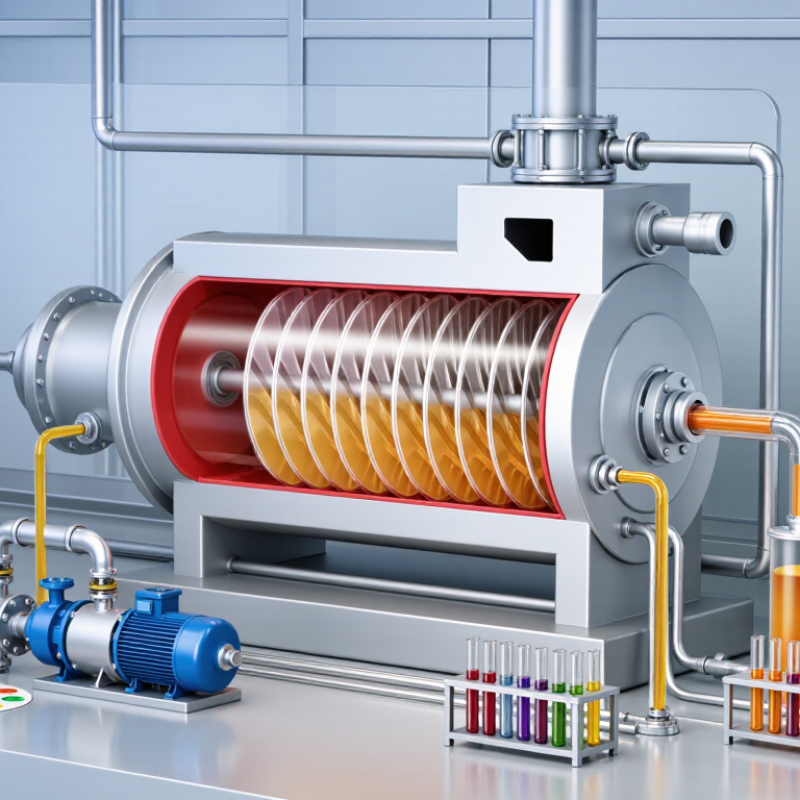
A horizontal thin film evaporator works by spreading liquid across the inside wall of a heated cylinder. A rotating shaft with blades continually renews this thin layer. Heat passes through the wall, vapor forms at the liquid surface, and the concentrated product moves toward the outlet. Vapor is routed to a separator and condenser. The exact flow path depends on the equipment design.
The U.S. Department of Energy’s 2015 process-heating sourcebook estimates that process heating used about 32% of U.S. manufacturing energy in 2010. That figure is not specific to evaporators, but it highlights why heat transfer and operating conditions deserve close attention. In practice, feed rate, rotor speed, vacuum level, and wall temperature shape film thickness and residence time. A thinner film can improve heat transfer, but it does not automatically prevent fouling or product damage.
When assessing an evaporator, look beyond rated capacity. Check whether the feed wets the full heated surface, and ask how the unit handles viscosity changes and cleaning. Short residence time matters. So does stable vacuum. Lab results can help, yet scale-up may expose uneven distribution or heat-sensitive spots. I would treat any single performance estimate cautiously; real feed behavior can be less tidy than a test sheet suggests.
A sound evaporator choice starts with a clear picture of the feed. Record its viscosity, solids content, boiling range, and temperature sensitivity. These values can change as solvent leaves, so test the feed at several concentrations, not just as received. A liquid that pours easily at room temperature may become a sticky film near the outlet.
Look closely at particles, crystals, and fouling tendency. Note whether the material foams, forms deposits, or degrades after brief heating. A small sample test can reveal behavior that a laboratory specification misses. Useful detail. Measure viscosity across the expected temperature range, and document any changes in color, odor, or product quality. Feed data is rarely tidy; that is a reason to verify it, not to guess.
Then define the process target: feed rate, desired evaporation duty, final concentration, and acceptable product temperature. Set a realistic residence-time limit for heat-sensitive materials. Specify available vacuum and heating-utility conditions, since they affect boiling temperature and capacity. Also consider cleaning frequency and whether the equipment must handle changing batches. Do not size around one ideal operating point. Real feeds vary, and a little uncertainty should be stated openly in the design basis.
Use the values below as an illustrative screening example, not as equipment guarantees. Confirm feed behavior, operating limits, and materials compatibility through testing and engineering review.
| Design Dimension | Data to Define | Illustrative Input | Why It Matters for Selection |
|---|---|---|---|
| Feed rate and variability | Normal, minimum, and maximum mass flow; batch or continuous operation; expected feed fluctuations. | Normal feed: 100 kg/h; operating range: 70–120 kg/h. | Establishes the required processing capacity and helps determine whether turndown and feed-control provisions are needed. |
| Composition and nonvolatile content | Solvent or volatile components, dissolved solids, suspended solids, and their proportions. | Illustrative feed: 80 wt% volatile component and 20 wt% nonvolatile material. | Defines the material balance, vapor load, product concentration, and potential for solids buildup. |
| Target concentration | Required product concentration, acceptable range, and whether the product must remain pumpable. | At 100 kg/h feed containing 20 wt% nonvolatile material, a 60 wt% nonvolatile product would be about 33.3 kg/h, with approximately 66.7 kg/h evaporated, assuming no material loss. | Determines the approximate evaporation duty and helps identify risks such as excessive viscosity or product solidification. |
| Viscosity and rheology | Viscosity versus temperature and concentration; shear-thinning, yield stress, or other non-Newtonian behavior. | Example measurement: 500 mPa·s at 80°C and the measured feed concentration. Measure again near the target concentration where practical. | Viscosity affects feeding, film formation, heat transfer, discharge, and the suitability of the rotor and clearances. |
| Suspended solids and particles | Solids concentration, particle-size distribution, hardness, abrasiveness, and tendency to settle. | Example: 2 wt% suspended solids, with a measured maximum particle size of 0.5 mm. | Large or abrasive particles can influence rotor design, wear, plugging risk, and the need for upstream screening. |
| Thermal sensitivity | Maximum acceptable product temperature, exposure-time limit, and evidence of degradation, polymerization, or discoloration. | Example process requirement: keep product temperature at or below 120°C; verify the limit with stability testing. | Helps establish heating-medium temperature, vacuum conditions, and the need to limit product exposure to heat. |
| Boiling behavior and operating pressure | Boiling-point data, vapor pressure, solvent mixture behavior, and desired operating pressure in absolute units. | Example starting point: 50 mbar absolute, subject to the feed’s vapor-pressure data and required evaporation temperature. | Pressure affects boiling temperature, vapor volume, condenser duty, and the required vacuum-system capacity. |
| Fouling, scaling, and deposits | Deposit formation, crystallization, coking, foaming, and any change in these behaviors as concentration rises. | Document whether deposits appear during a representative test and record the operating time before performance changes. | Fouling behavior can reduce heat transfer and determine cleaning frequency, operating strategy, and equipment configuration. |
| Product quality requirements | Acceptable color, odor, residual volatile content, purity, and limits on thermal degradation. | Example specification: residual volatile content below 1 wt%, measured using an agreed analytical method. | Provides measurable acceptance criteria for selecting operating conditions and validating the process. |
| Materials compatibility | Feed and condensate chemistry, including corrosive species, cleaning agents, and temperature-dependent compatibility. | List all process and cleaning chemicals with their concentrations and operating temperatures; confirm material suitability with a qualified materials review. | Supports appropriate selection of wetted materials, seals, and gaskets while reducing corrosion and contamination risk. |
| Cleaning and operating mode | Required cleaning method, cleaning frequency, changeover time, and whether the process is continuous or batch-fed. | Example requirement: clean between product campaigns using a validated rinse and cleaning procedure. | Influences accessibility, drainability, operating schedule, and the practical design of the process system. |
Choosing a horizontal thin film evaporator starts with the feed, not the equipment drawing. Note its viscosity, solids content, heat sensitivity, and tendency to foul. A high-viscosity stream may need a rotor and clearance suited to steady film renewal. Heat-sensitive material often benefits from short residence time and carefully controlled wall temperature. Check whether the proposed design can maintain a thin, even film as feed rates change. The comparison is rarely neat; laboratory behavior may not match a full-scale unit.
Tips: Compare wetted materials against the feed’s chemistry and cleaning method. Ask for operating limits, not just nominal capacity. Review the rotor, seals, heating jacket, vacuum connections, and discharge arrangement together. Small details matter.
Stainless steel may suit many services, but corrosive feeds can require a more compatible alloy. Confirm material compatibility with qualified engineering data. Consider whether the configuration supports your actual process: continuous operation, frequent cleaning, or variable throughput. A larger heating area is not automatically better if distribution is poor. Nor is a tighter rotor clearance always ideal; solids and viscosity can change the trade-off. Request performance data at conditions close to your own, then validate uncertain points with a pilot test where practical. One decision may still feel imperfect. Document the assumptions, especially feed variability and cleaning frequency, before comparing quotations.
How to Choose a Horizontal Thin Film Evaporator?
Start with the feed, not the machine’s headline capacity. Record the usual flow rate, solids content, viscosity, and temperature sensitivity. Then ask suppliers to size the unit for real operating conditions, including expected changes in feed composition. A unit that handles a brief peak may struggle during a full shift. Leave some capacity margin, but avoid paying for an oversized system that runs inefficiently.
Energy use depends on more than the heater. Review the required evaporation duty, available steam or electrical supply, vacuum level, and condenser performance. Ask for energy estimates at your actual operating range, not just ideal conditions. Compare heat recovery options where suitable. Small gaps between estimates and plant readings can matter over time. They are easy to overlook.
Controls should make key conditions visible: feed rate, product temperature, vacuum, and rotor speed. Clear alarms help operators respond before product quality drifts. Check whether settings can be adjusted without stopping the process. Maintenance access deserves equal attention. Inspect how the design allows cleaning, seal checks, and wiper-blade replacement. Ask how often routine service is expected, and what tools are needed. A compact layout may save floor space, but it can make repairs awkward. That trade-off is worth questioning.
Assess capacity, energy use, controls, and maintenance needs
Use these illustrative weights as a starting point, not as measured equipment performance. Confirm required throughput, feed properties, energy consumption, control requirements, and cleaning access against your process and supplier specifications.
When choosing a horizontal thin film evaporator, treat supplier support as part of the equipment package. Ask for a written commissioning scope, response times, operator training, and a list of stocked wear parts. Request references involving similar feed viscosity, throughput, and cleaning needs. A polished brochure cannot show how quickly help arrives when a batch schedule slips. Small details count.
Review safety features with the people who will operate and maintain the unit. Check access to the rotor and seals, guarding, hot-surface insulation, vacuum protection, and lockout points. The U.S. Department of Energy’s Operations & Maintenance Best Practices Guide (2010) notes that maintenance can account for 15–40% of production costs in industrial settings. The range is broad, but it makes service access and preventive maintenance worth pricing carefully.
Tips: Build a five-year ownership estimate covering energy, labor, seals, cleaning, planned downtime, and service travel—not just purchase price. Ask suppliers to state their assumptions and warranty exclusions in writing. Compare support plans against your site’s shift pattern. The estimate will still be imperfect; real fouling rarely follows a neat spreadsheet.